“This is my 13th year in Africa, and I will continue to pursue my career here,” says 40-year-old Jacky Huang, managing director of Good Time Steel Zambia Limited.


Mr Huang, a Chinese national, has given himself the screen name 'Seek dreams in Africa' on his WeChat account, the popular text and voice messaging service developed by China’s Tencent.

While his two sons and wife live in Canada, Mr Huang spends most of his time in Zambia. He has also worked in Algeria and Nigeria.

“As a professional manager, the most rewarding part of working in Africa is that I got the extraordinary opportunity to realise my individual value, while the most challenging part is being separated from family,” says Mr Huang.

Despite the distance from loved ones, he chooses to stay.

Many Chinese who have established themselves in Africa share this feeling. During the boom years of the commodities super-cycle and China’s rapid economic expansion, Chinese migrants travelled thousands miles to seek opportunities in Africa’s fast growing frontier economies.

Many arrived without friends or relatives, only the belief that this new place offered business opportunities. Now, despite slowing growth across emerging markets and China’s new directive to re-balance the economy towards internal demand, many intend to stay on.

Although there are no official figures available, estimates suggests that there are at least one millionChinese immigrants currently working and living in Africa.

China became Africa’s largest trading partner in 2009. Today, the continent is also the Asian giant's second largest market for overseas project contracting and fourth largest for outward investment.

For the past decade, many profit-seeking Chinese investors and companies have come to believe there is nowhere in the world to do business like Africa. This is particularly true for engineering and construction firms, which have brought over Chinese workers in droves.

Chinese firms feel their advantage in African markets is strong when compared with others, where the domestic construction industry might have strong local contractors to compete against or fewer large-scale construction projects on offer.

At Addis Ababa Bole International Airport in early February, for instance, shops were festooned with decorations and gifts for Chinese Lunar New Year. Hundreds of Chinese construction and factory workers boarded direct flights to Guangzhou and Beijing to visit family for the holiday. 

All the workers This is Africa spoke to planned to return to Africa after a week or two’s break.

Tied fortunes

As a result of these linkages, China and Africa are now closely tied economically. Shifts in one affects the other.

According to the Interational Monetary Fund, a 1 percent decrease in China’s investment growth is associated with an average 0.6 percent decrease in Africa’s export growth rate.

Due to the fluctuating yuan, lower global commodity prices, falling Chinese demand and a saturated job market compounded by overpopulation, China’s GDP expanded 6.9 percent in 2015, down from 7.3 percent in 2014. This is the slowest growth rate in 25 years.

The economic slowdown in China has also led to an 18.3 percent decline in bilateral trade with Africa, from $220bn to $170bn in 2015, according to official figures from the China State Council. Greenfield foreign direct investment into Africa fell 84 percent in the first two quarters of 2015.

The effects of a downturn in China are already impacting African countries, especially those highly dependent on natural resources. In Zambia, where the economy is highly dependent on the copper mining industry, output has fallen drastically due to a collapse in global copper prices, driven in part by lower Chinese demand for raw materials.

The copper industry has further suffered from severe national power shortages and an unpredictable mining tax regime.

Several foreign mines, including the Chinese state-owned CNMC Baluba mine, have suspended production. More than 10,000 workers have been laid off across the sector. According to Chinese Economic and Commercial Counsellor’s office in Zambia, trade between China and Zambia in 2015 decreased 38.09 percent year on year.

“The withdrawal of many Chinese investments in Africa is inevitable due to the still-weak global economy, and it is just a matter of time,” says Jinghao Lu, the project director of the Kenya-based Sino-Africa Center of Excellence Foundation (SACE).

Political and economic uncertainty are also ongoing concerns for Chinese investors. In Zambia, for example, many foreign companies are taking a wait-and-see attitude ahead of a general election scheduled for August 11, 2016.

“Two-thirds of our Chinese employees went back to China for a holiday. Our project in Zambia has shut down for half a year due to a gloomy economy in Zambia, and the government is not able to pay most fees,” a source from China State Construction Engineering, a state-owned construction conglomerate, tells This is Africa.

The company has signed several road construction deals with the government of Zambia worth in excess of $300m between 2014 and 2016.

Commitment remains

Pessimism is only partly warranted. Despite its economic slowdown, China has reaffirmed its commitment to Africa, pledging to invest $60bn across the region over the next three years during the Forum on China Africa Corporation Summit 2015.

Where China’s government leads, investors and entrepreneurs will continue to follow. In order to adapt to the changing economic context, many Chinese businesses are looking for ways to localise their businesses by investing in training locals and creating niche businesses outside the extractive sectors.

Jihai Agriculture, for instance, is focused on its ‘go local’ campaign with the aim of creating a mushroom industry in Zambia. The enterprise is co-operating with the Zambian ministry of agriculture and livestock to promote the mushroom industry, and to extend it to various provinces in Zambia through training and financial support.

Managing director of Jihai Agriculture Yunwu Yao remains optimistic about his business prospects in Zambia. Mushroom cultivation is already a flourishing industry in China. Mr Yao believes that Zambia can become the hub of mushroom production and marketing in Africa. “I believe Zambia is a peaceful and friendly country, its economy will continue to progress. I also believe agriculture is a sunrise industry and it has a promising future,” says Mr Yao.

Already, Jihai Agriculture is producing 5 tons of oyster mushrooms and king oyster mushrooms daily. Most of their output is destined for local markets, but with an eye to expanding exports to the Far East in the future.

Staying on

Mr Yao and his entrepreneurial cohort represent a new phase in Chinese migration to Africa.

According to China House, the continent’s first social enterprise focused on helping Chinese companies and individuals forge positive connections with African communities, Chinese immigrants’ interests in Africa have diversified following the main waves of the early 2000s.

Based in Nairboi, Kenya, most of China House’s members have international backgrounds and advanced degrees from top universities around the world. This is a shift from the labourers and tradesmen, often from China’s working class provinces, that characterised earlier migrant waves.

SACE, for instance, continues to bring young Chinese graduates interested in getting work experience in Africa to work with and learn from African companies. Most of its trainees speak English and try to integrate with Kenyan culture. 

According to SACE’s Mr Lu, besides work experience, many graduates who come to Kenya are interested in touring the region. Hongxiang Huang, founder of China House, believes “the new Chinese blood” will have a positive impact on future relations with African countries.

Historically, there have been some tensions between Chinese immigrants’ cultural and business practises and locals.

In Zambia, Chinese mine owners have been accused of labour rights violations in order to increase profits, causing discontent among workers. Ghana has on several occasions deported swaths of illegal Chinese miners.

In Kenya, allegations of Chinese restaurants intentionally discriminating African patrons raised questions about the growing Chinese community’s integration in Kenya.

Some of this is due to perceptions of risk. Mr Huang of China House says that Chinese employers, who play a significant role in Chinese employees’ daily lives, remain apprehensive about security threats.

“Many of them do not allow their Chinese employees to go out during evening. They do not like their employees having too many local friends as they are afraid of company information leakage, which might cause troubles,” he explains.

Though some Chinese migrants are willing to engage, learn local languages, explore rural areas other non-Africans rarely go and to engage in all forms of labour, the public perception is that on average Chinese migrants’ integration remains low.

But as Chinese immigrants become a more permanent fixture in African societies, more needs to be done to bring locals and newer arrivals together.

Image copyrightEPAImage captionMore than 6,000 police have been deployed around Hong Kong, a substantial portion of its police service

Tight security is in place in Hong Kong for the visit of the most senior official from Beijing since large pro-democracy protests in 2014.

Zhang Dejiang, the leader responsible for Hong Kong affairs, arrived amid discontent with alleged interference by Beijing.

Mr Zhang said he was in Hong Kong "to listen to all sectors of society".

More than 6,000 police have been deployed amid planned protests by pro-democracy groups.

In a five-minute speech on arrival, Mr Zhang, 69, conveyed "President Xi Jinping's warm regards and well wishes for the people of Hong Kong" and said he came "with the care of the central government and all Chinese people".

Noting his trip had "attracted wide attention", he said: "I will listen to the chief executive and the [Special Administrative Region] government regarding their work, and to all sectors of society about what recommendations and requirements they have about implementing the principles of "one country, two systems".
Who is Zhang Dejiang and what is he doing on the trip?

He heads China's Hong Kong and Macau affairs office but is also chairman of the National People's Congress Standing Committee, making him China's third-highest ranking leader after President Xi and Premier Li Keqiang.Image copyrightAPImage captionZhang Dejiang brought the "warm regards" of the president

Mr Zhang is to speak at a policy conference on President Xi's One Belt, One Road economic project that aims to improve connectivity between China and Eurasia.

He will meet a group of four pro-democracy legislators at a reception, ahead of a banquet.
Why is the trip contentious?

As head of Hong Kong affairs, Mr Zhang was responsible for a key decision in 2014 on Hong Kong's political future and is the highest-ranking mainland official to visit since then.

The mini-constitution, or Basic Law, under which Hong Kong is governed, says the ultimate aim is for the leader to be elected by universal suffrage.

Although China had promised direct elections by 2017, it said in 2014 that the leader, or chief executive, put up for election would come from a list of two or three candidates chosen by an effectively pro-Beijing nominating committee, angering pro-democracy campaigners.Image copyrightAFPImage captionA protest in September 2014, following a key political ruling

The decision led to full-scale protests, dubbed the Umbrella Movement. Tens of thousands of protesters camped in the streets for weeks but the camps were gradually dismantled with no concessions from the government.

Current Chief Executive CY Leung remains unpopular. Commentators will be watching and listening carefully to see whether Mr Zhang will hint at endorsing him for another term.
Who are the protesters and what are their concerns?

Following the 2014 protests, a number of so-called "localist" groups sprung up and showed themselves willing to use violence to battle what they see as a dilution of the city's identity, fearing growing social and political influence from mainland China.

In February, hundreds of demonstrators dug up and threw bricks during a violent clash with police trying to shut a night food market. The market was seen by the protesters as a symbol of local traditions.

There have also been increasing concerns over the freedoms Hong Kong enjoys - unseen on the mainland - which were integral to the agreement that enabled Hong Kong to be returned to China by the British in 1997.Image copyrightAPImage captionRioters in Mong Kong in February lifted the lid on the so-called "localist" groups considered a more radical force in Hong Kong politics

They include freedom of speech, the press, assembly, association, travel and trade union membership.

One incident that raised particular concern was the disappearance of five Hong Kong booksellers known for publishing controversial books about Chinese leaders.

The men were later found to have been detained by mainland authorities in a move condemned by the UK.
What are the security measures for the visit?

In addition to the 6,000 police officers on duty, hundreds of huge, water-filled plastic barriers have been deployed near Mr Zhang'sHOTEL and the convention centre at which he will speak.

Demonstrators will be given designated areas and are unlikely to be visible to Mr Zhang.

Pavement stones have reportedly been glued together to prevent them from being ripped up and thrown by protesters.

The South China Morning Post said security was tight at the airport for Mr Zhang's arrival. It said guards reportedly took away journalists' umbrellas, along with a small yellow towel used by one reporter to cover a camera lens.Image copyrightEPAImage captionA giant banner calling for universal suffrage was swiftly removed from Hong Kong's Beacon HillImage copyrightEPAImage captionWorkers in Hong Kong were seen gluing down paving stones earlier this month, with lawmakers speculating it was to secure them ahead of the visitImage copyrightEPAImage captionHuge barriers have cordoned off security zones in central Hong Kong

The colour yellow, along with umbrellas, has become a symbol of the pro-democracy movement.

Hours before Mr Zhang landed, activists unfurled a yellow banner on Hong Kong's Beacon Hill reading: "I want genuine universal suffrage". The banner was later removed.

On Monday a Hong Kong man was arrested just over the border in Shenzhen for trying to buy a drone purportedly to be used to disrupt the visit.


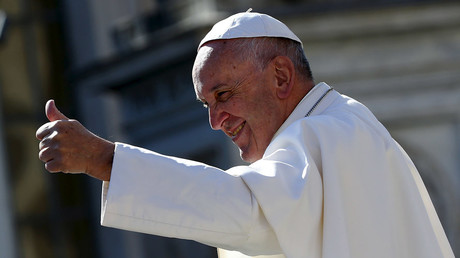
Pope Francis believes that a healthy secularism paired with a strong law that grants above all a religious freedom is the key to a successful and peaceful state, while states tied to a single religion don’t have a future.
“Confessional states end badly…I believe that secularism accompanied by a strong law which guarantees religious freedom provides a framework for moving forward,” the Pontiff said in an interview with Guillaume Goubert, director of French Roman Catholic newspaper La Croix.


Читать
Pope Francis 

The royal road to peace is to see others not as enemies to be opposed but as brothers and sisters to be embraced.


Addressing increasing worries of Christians that Islam is becoming ever more widespread in Europe, Pope Francis says that everyone has a right to exercise the religion he or she chooses, and a secular state as opposed to a single-religion one can grant this opportunity.
“We are all equal, as sons of God or [creations] of our personal dignity. But everyone should have the freedom to exercise their own faith. If a Muslim woman wants to wear a hijab, she should be able to. Similarly so, if a Catholic wants to wear a cross. We must have an opportunity to profess our faith not on the sidelines of the [national] culture but within it,” Francis said.
He mildly criticized France in this regard, where concerns over Islam and its confusion with extremism have been spreading exponentially following terror attacks that rocked its capital.

“The small criticism I’ll be addressing to France in this regard is that France exaggerates secularism. This stems from a way of considering religion as a subculture and not a whole culture. France should take a step forward on this issue to accept that openness to transcendence is everyone’s right.”
When asked about current controversial social issues, such as the legality of euthanasia or same-sex marriages, the Pontiff once again stated that social issues must be dealt with by secular authorities, but that people's personal beliefs and convictions should be respected when a certain law is adopted.
“It is the parliament that must discuss, argue, explain, reason. Thus the society will evolve and grow. But when the law is passed, the state must respect [religious beliefs]. In each legal structure, objections of conscience must be present for it is a human right. Including for a government official, who is also a human being,” Francis said, adding that a truly secular state cannot exist without criticism and respect for its people and their beliefs.
“The state must respect criticism. That is true secularism,” Francis said.

Russian Foreign Minister Sergei Lavrov (L), Armenia's President Serzh Sargsyan (2nd L), U.S. Secretary of State John Kerry (C) and President Ilham Aliyev of Azerbaijan (R) attend a meeting in Vienna, Austria, May 16, 2016. © Leonhard Foeger / Reuters
AddThis Sharing Buttons356
Leaders of Armenia and Azerbaijan supported the ceasefire in the disputed Nagorno-Karabakh region, promising to seek a non-military resolution to the heated conflict in a statement issued by the OSCE following a Minsk group meeting in Vienna on Monday.


Leaders of the rival states met on the highest level for the first time since the brief escalation in the protracted territorial conflict early in April, which saw the sides attacking each other with artillery, tanks, and rockets, while accusing one another of provoking the hostilities. After three days of shellingresulting in multiple casualties and an ensuing blame game, a Russia-brokered ceasefire was enacted following a meeting between the countries’ chiefs of staff in Moscow on April 5.
Armenian President Serzh Sargsyan and Azeri President Ilham Aliyev agreed in Vienna to adhere to the original provisional ceasefire agreement that was brokered to terminate the increasingly violent ethnic conflict of 1994-1995. Hostilities between ethnic Armenians living in Azerbaijan’s enclave of Nagorno-Karabakh and the central Azeri government erupted in the late 1980s.
“They reiterated that there can be no military solution to the conflict. The Co-Chairs insisted on the importance of respecting the 1994 and 1995 ceasefire agreements,” reads the OSCE statement, referring to the position of the meeting’s co-chairs – Russian Foreign Minister Sergey Lavrov, US State Secretary John Kerry, and State Secretary for European Affairs of France Harlem Desir – with regard to the flared-up conflict in the border area.
Sargsyan and Aliyev also expressed their readiness to further “reduce the risk of violence” in the area by establishing a new OSCE mechanism that would thoroughly investigate all incidents occurring along the contact line of the Nagorno-Karabakh conflict zone and provide for an exchange of data on missing persons under the aegis of the Red Cross.Commenting on the feasibility of finding a peaceful resolution to the Nagorno-Karabakh conflict, Lavrov stressed at a press-conference on Monday that there was room for compromise between the previously warring parties.


“At least, if there was no such a possibility, then Russia, the USm and France would stop engaging in it [peace talks],” he said, as cited by TASS. Lavrov emphasized that the mediators’ aim is to end the conflict altogether, saying that the ultimate goal is to “start moving forward to the full settlement of the conflict.” 
However, taking into account the existing tension between the sides, international negotiators will have to employ a gradual approach, Lavrov stressed.
It was agreed that the next meeting between Sargsyan and Aliyev, which is expected to pave the way for a final settlement of the dispute, is to be held at a yet unknown location in June.
As the conflict came to the boiling point earlier in April, Armenia said it would recognize Nagorno-Karabakh’s independence if Baku continued to shell the breakaway Republic, vowing to “continue to fully carry out its obligations in providing security for the population in Nagorno-Karabakh,” while looking into the possibility of “working on a military cooperation treaty with Karabakh.” 
Azerbaijan submitted pleas to the UN, NATO and the EU in response, demanding that Yerevan “free all occupied territories, and provide complete territorial integrity and sovereignty of the Republic of Azerbaijan, recognized on international level.”

Three people were injured in Turkey after Eskisehirspor football fans trashed their own stadium and set it on fire following a 2-1 defeat to Medipol Basaksehir. Luckily, the team is set to move to a newly built stadium next season.
As the final whistle blew, disappointed supporters began to slowly and sorrowfully destroy the stadium, tearing out seats, setting bleachers and billboards on fire, and throwing them down onto the pitch.


Running onto the green, the fans overturned the goals in a demonstration of disgust for their team, which had just been defeated 2-1 in its last home match of the Turkish Super Lig by the Medipol Basaksehir football club.
According to local media, the 1953-built stadium was ruthlessly vandalized because the building is set to be demolished to make way for an urban park at the end of this season anyway. Eskisehirspor will play at a newly constructed 33,000-seat stadium next season.

Image copyrightJAMES DREW

The Boss
The rise of popular lesbian dating app Her
The man who bet his house on his invention
Sisters open romance-only bookshop
The filmmaker who swapped communism for Hollywood

Ted Nash realised that his gossip website had somewhat backfired when a media scrum descended upon his parents' home in rural south-west England.

Aged 19 at the time back in late 2010, and still living with his mum and dad in Somerset, Mr Nash had developed a website called Little Gossip, where schoolchildren could anonymously post news of interest to their fellow pupils.

Mr Nash, now 25, says he had the best of intentions, but things very quickly went wrong.

The website was an immediate viral hit, gaining 33,000 users in just its first hour, then hundreds of thousands across the length and breadth of the UK within a few days.

Unfortunately, at least 10% of the comments posted were malicious. And amid accusations that it was a bullying free-for-all, schools and parents were soon loudly complaining.

And Mr Nash was doorstepped by tabloid reporters and TV crews.Image captionThe woes at Little Gossip were widely reported

Mr Nash says: "My mum walked out one morning in her dressing gown to open the front gate for someone, and suddenly there were reporters asking her, 'Does Ted Nash live here?'

"She ran back inside, shouting to me, 'What have you done?'"

With the story being widely reported across national UK newspapers, and on TV, Mr Nash shut down the website a few months later.

A serial technology entrepreneur, who set up his first money-making website when he was just 12 years old, Mr Nash describes Little Gossip as "an unbelievable learning curve".

He says: "As is more often the case, I came up with the idea for the website to solve my own problems.

"At school I was always much more interested in building a company. Because of that I felt that I had missed out on a huge amount of gossip and socialising, so I thought something like Little Gossip would be very useful, and it was started with good intentions.

"Unfortunately it was a sad state of affairs that you couldn't allow some people to be anonymous [without them abusing it], and we had to close it."
'Spark'

Now chief executive of a start-up technology company called Tapdaq, which aims to help small mobile phone apps more easily grow user numbers, Mr Nash is already 13 years into a busy and eventful business career.

At 17 he made almost £3m when threeMILLION people around the world paid 99 cents to download an app he had developed called Face Rate, and then he subsequently spent 18 months helping Rupert Murdoch's UK newspaper group, News UK, develop its mobile presence.Image copyrightTED NASHImage captionMr Nash says he was 12 when he caught the business bug

But Mr Nash says it all started when, aged 12, and on a familyHOLIDAY in Spain, he was inspired by an 18-year-old he met who had made a decent amount of money by developing an early internet search engine.

"I saw all the material items that he had, and me being 12 I wanted that as well.

"It completely set off a spark in my head, and from that point onwards I was just fascinated by technology and the impact it can have. And, of course, the money it can make.

"At that age all I could think about was buying the next toy - literally. But [as] you get older you realise that the money is not so important, and that it is a subset for building something of value for other people to use."

Returning to the UK, Mr Nash set to work on learning how to build websites, and still just 12, was successful with one of the first ones he built. Called Rediz, it was an online shopping index, with links to shopping websites.Image copyrightJAMES DREWImage captionTapdaq is based in London

Mr Nash was savvy enough to build up a user base, and he was soon getting paid by retailers for each customer who clicked through to their websites from his.

"I was earning the kind of money that 12-year-olds shouldn't, but I had to get my parents to sign all my contracts, because I was obviously too young."

Many of Mr Nash's other websites, including an attempt at a search engine, were far less successful.

He says: "From age 12 to 16, it was pretty much all trial and error. I built [metaphorically speaking] thousands of websites, the majority of which didn't see the light of day."

Support, advice and occasionalINVESTMENT along the way came from Steve Pankhurst, the founder of one-time UK social networking website Friends Reunited. Mr Nash had met Mr Pankhurst via his father.
'Billion dollar'

After Rediz, Mr Nash's next big hit was Face Rate, an app that measured - or at least tried to measure - how attractive a user was. It went viral, and Mr Nash says he "made an obscene amount of money for a kid of that age".Image copyrightTAPDAQImage captionMr Nash has big ambitions for Tapdaq

The ignominy of Little Gossip then followed, before Mr Nash helped the Times and Sunday Times newspapers improve their digital presence.

Mr Nash says his sole attention since 2013 has been London-based Tapdaq, which helps mobile phone apps cross-advertise on each other's platforms, thereby helping them to more easily build up user numbers. He says it has so far secured financial backing of $8m (£5.5m).

The ambitious Mr Nash has high hopes for the company, which he says "could become a multibillion-dollar business".

"For me being an entrepreneur is both a blessing and a curse," he says. "I'm always thinking [of business ideas]. It keeps me awake at night."

Image copyrightAPImage captionSupporters were encouraged to destroy "the four olds": old customs, old culture, old habits, and old ideas


Chinese people aged over 50 experienced the Cultural Revolution first hand.

If you were born in 1966, you were 10 when it finished.

If your parents were academics, artists, or government officials, you may have seen them dragged into the street by a mob of youths, tied up, humiliated and possibly beaten to death.

Some themselves were doing the bashing, burning and destroying of the "old culture". Others toiled away in the fields to learn from hard-working peasants the real way to think.


For a decade, nearly all university education was put on hold, institutions like hospitals could barely function, and chaos reigned, as Mao Zedong took back the reins of the Communist Party and tried to thrust the entire country into a heightened state of revolutionary awareness.

Death toll estimates vary butMILLIONS are thought to have died.Image copyrightAFPImage captionWith the teacher-student relationship turned upside-down, it was also a chance for pupils to settle scores

So it does seem remarkable that on this, the 50th anniversary of such a massive upheaval, there would be almost no coverage of it at all in China.

Major state-run newspapers and television stations have had nothing to report.

Phoenix Television is a Communist Party-controlled outlet coming out of Hong Kong. It is sometimes more liberal than its mainland counterparts.

On this occasion, Phoenix prepared a special online feature about the Cultural Revolution anniversary, but the link has now been frozen.

Yet it is not a blanket censorship policy as with, say, discussion of the 1989 Tiananmen Square crackdown.

On China's Twitter-like Weibo, the Chinese words for "Cultural Revolution" have not been blocked.Image copyrightAPImage captionVendors at a curio market in Beijing hang up a 1969 banner of the arch enemy of capitalism, to help sell trinkets on the anniversary of the Cultural Revolution

On the Sina News website there is no article, but they have posted a Communist Party document from 1981 that states that the Cultural Revolution was created by Chairman Mao Zedong and "caused the most serious setback and loss for the Party, the country and the people, since the founding of China".

The document also says that this political movement had nothing to do with Marxism, Leninism "nor the reality of Chinese society".

What is more, it added that after the death of Chairman Mao, the arrest of his widow Zhang Qing and the other members of the "Gang of Four", would "save the Party and the revolution from this crisis and help our country enter a new period".

Somebody at Sina News has worked out that it would look pretty bad for the censors to block an official Communist Party document.Image copyrightAPImage captionLater tried for her part in the chaos, Mao Zedong's widow Jiang Qing claimed she was being scapegoated for her husband's orders

The firebrand pro-Party newspaper The Global Times has not said much, but it does have an online page featuring a single photo of a woman eating noodles in front of a portrait of the Mao Zedong.

The headline reads: Anniversary of tragedy.

Under the photo are these lines: "A vendor eats noodles next to a poster of late Chinese leader Mao Zedong, at a market in Beijing on Sunday.

"Monday marks the 50th anniversary of the beginning of the Cultural Revolution (1966-76), where memories of Mao remain divisive among different groups."

Global Times editor Hu Xijing posted this himself on Weibo: "The homes of my parents and grandma in Beijing were raided because they were categorised as 'landowners'.

"It was my scariest memory - when I was six, the Red Guards pushed my grandma to the ground and called her a 'landlady'.

"They slapped her and she cried. My grandma was then forced to leave Beijing. My father was her only child and my grandma's relatives were the only ones who could take care of him.

"From a very young age, I had to write down 'landowner' in every form I filled in. I felt very ashamed. The Cultural Revolution - a memory so hard to look back on!"

Yet many have responded on Weibo accusing the pro-Party editor of hypocrisy because his paper has hardly touched the issue.

One person wrote: "This is Stockholm Syndrome. This man has developed emotions for the people who have committed crimes against him and has even started helping them."

None of this subsequent discussion online has been taken down.Image copyrightGETTY IMAGESImage captionMany of those that died were killed in fighting when central government finally reasserted its authority

So why allow a certain amount of coverage rather than completely ban discussion?

It does allow officials to say they are not afraid of mentioning the Cultural Revolution.

Another factor is that so many people suffered through this period, including senior figures in today's leadership.

Even President Xi Jinping's father - one-time hero of the revolution, Xi Zhongxun - was labelled an enemy of the Party, publicly humiliated and jailed.

There are those here, even some in powerful positions, who think that there has never been an adequate accounting for these events. Few of the students who murdered their teachers have been brought to justice.

What is more, they believe that young Chinese people need to learn from the mistakes of the Cultural Revolution and that it should be spoken about publicly.

But the more prevalent attitude of the current administration seems to be: let this painful period pass, there is no need to dwell on what is bad, and what is now over

Image copyrightNARENDRA MODIImage captionMr Modi became prime minister after his BJP party won the general election in May 2014


Twitter users have praised Prime Minister Narendra Modi's decision to post pictures of his mother's first visit to his official residence in Delhi on social media.

Heeraben Modi, who is in her nineties, lives in her family house in a town in Gujarat, Mr Modi's native state.

He tweeted that he "spent quality time with her after a long time".

Mr Modi became prime minister after his BJP party won the general election in May 2014.

"My mother returns to Gujarat. Spent quality time with her after a long time & that too on her 1st visit to RCR [Race Course Road]," Mr Modi tweeted.
Prime Minister Narendra Modi with his mother Hiraba at the 7RCR in New Delhi during the latter's first visit to the PM's residence.Image copyrightNARENDRA MODI
Most Twitter users praised Mr Modi's decision to invite his mother to his residence in Delhi.

The albino who confronted a witchdoctor
By Vibeke VenemaBBC World Service


Image copyrightSMART FACTORY

In today's Magazine
The Irishman who faked his own kidnapping
The personal SOS messages the BBC used to send
China calligraphy sets auction record

Stephane Ebongue fled Cameroon because of the colour of his skin - his albinism made him a target for those who believe such people have special powers. Years later he returned home to confront a witchdoctor, and to question him about the practice of using human body parts in "magic" potions.

Stephane Ebongue stands nervously at the edge of a forest trail, dressed in a suit and carrying a briefcase. His dark sunglasses are a necessity because he has albinism, but they also hide his nervousness. "My heart is beating fast. I have never come to a place like this before," he says.

This is the day he hopes to find answers he has spent years searching for. The trail leads to a witchdoctor who trades in albino potions.

"I would like to find out why albinos keep getting killed. Maybe the secret lies at the end of this path," he says.

Ebongue is a journalist, a rational man who deals in facts. He does not believe in magic, yet he is deeply unsettled about this meeting.

Across Africa, in countries such as Tanzania, Malawi and Ebongue's own country, Cameroon, there is a belief that people with albinism bring luck or have magical powers. This has devastating consequences for those with the condition.

"It is believed that parts of an albino, such as their heart, hair or fingernails, are important to make magical potions - for instance to fertilise the soil, to become invincible, to win political elections or a football match," says Ebongue.

"This is why albinos are killed and mutilated for the parts of their body."

In Africa I had three enemies: the sun, people's disgust and fearStephane Ebongue, Journalist

According to a recent UN report, such body parts can fetch prices from $2,000 for a limb to $75,000 for a "complete set" - a whole body.

Ebongue was 15 when his older brother, Maurice, who also had albinism, went missing 30 years ago.

"He went out one morning and did not come back," says Ebongue.

Days later the family found the 18-year-old's body in some bushes. He had been mutilated. "His stomach was opened - I don't know what was missing inside," says Ebongue.

Ebongue's parents tried to give their two sons with albinism a normal childhood - they treated them the same way as their other children - so it wasn't until he first went to school that he realised he was different. His classmates would ask him, "Why is it that you are white and we are black?"

"They were coming to touch my skin thinking that I had put talcum powder on there," he says.

At first he got into fights at school but his parents, both teachers, knew what to do.

"They understood the problem and pushed me to study harder.

"My revenge was that I was always the first in my class."

The trouble was that like most people with albinism, Ebongue had very poor sight, which made it difficult for him to read small print or see the blackboard, even when he sat at the front of the class.Image copyrightGETTY IMAGESImage captionBecause of their low vision, children with albinism struggle to read the blackboard in class

"During official exams there were many times where I had to hand in a blank sheet of paper," he says. "Not because I wasn't up to the task, but because the script was written so small that I could not read it. I had to give back a blank sheet of paper and go out crying."

He swore to himself that he would one day create a library where visually impaired people like himself would be able to read with ease.

Ebongue went to study journalism and English literature at university, where he was the only student with albinism out of 10,000. His uniqueness made him a point of reference in the local community. "People would say, 'Where the house of the albino is, meet me there,'" he says.

By 2007, at the age of 37, he was married and working as a journalist in Buea, in the shadow of Mount Cameroon, one of Africa's most active volcanoes.

It was the volcano that caused a huge crisis in Ebongue's life.

"It is believed that when there is an eruption it means Epasamoto, the god of the mountain, is angry," says Ebongue. "To calm him down they need the blood of an albino."

When the volcano had erupted in 1999, lava flowed down the side of the mountain, stopping just short of Buea. There were no casualties, but the traditional doctors claimed that the town had been spared only because albinos had been sacrificed.Image copyrightGETTY IMAGESImage captionPeople flee a river of molten lava during Mount Cameroon's 1999 eruption

In 2007 there were fears of a new eruption and people were doing "everything possible" to stop it. At times like this, when what Ebongue calls a "general psychosis" takes hold, people with albinism go into hiding.

Fearing for his life, Ebongue decided to go abroad. His wife and three children, none of whom had the condition, were safe - they could follow at a later date, he thought.

He found a captain willing to smuggle him on board a ship carrying timber to Italy, and spent 33 days hidden in the dark hold.

"I was asking myself many questions without answers, so it was mentally and psychologically very difficult," he says.

"I was suffering. I had left my wife and my children, I had left my job, I had left my country, I had left my friends."

Soon after arriving in Genoa, Ebongue was granted refugee status on humanitarian grounds.
Find out more
To celebrate Outlook's 50th birthday the team have brought together the stories of some of the most inspirational people they have interviewed - look at their website for details.

Living in Italy was liberating. For once, his colour was an advantage - other Cameroonians would regularly be stopped by the police, whereas he was not.

"When I lived in Africa I had three enemies: the sun, the people's disgust and the fear," he says.

"Here, I don't have such problems. I feel freer here, I feel free to move, I'm not ashamed."

In his new home, Ebongue found he was provided with specialist sun cream as well as a magnifier, to help him read. He had never seen anything like it before - and when he saw what it could do, he burst into tears. Before it would take him two months to read a novel. With the magnifier he read 10 in a month. "I was trying to make up for lost time," he says.

The experience made him even more determined to build a specialist library in Cameroon.Image copyrightLE PAVILLON BLANCImage captionMagnifiers such as this one can help people with albinism read

Ebongue soon learned Italian and settled in Turin, where he taught the language to new arrivals, and made a new friend in local journalist Fabio Lepore.

The two men bonded because Lepore, too, has a visual impairment. His is caused by macular degeneration - Stargardt disease - which means he has 2/20 vision in both eyes. "I was lucky because I started to lose my sight at the age of 16, so I could learn how to do without," says Lepore. "I can't drive a car - but I can paraglide."

They began working on a documentary about Ebongue, called Jolibeau's Travels - Jolibeau is the nickname he is known by at home in Cameroon.

And this is why, five years later, Ebongue was standing by the side of a road in Cameroon, about to meet a witchdoctor, and struggling to keep control of his emotions.

"I was there as a journalist," he says. "I wanted to meet somebody who could explain to me the deep roots of those beliefs, and I thought a native doctor could do that."

At the same time, he knew that many people with albinism - among them his own brother - had died at the hands of people like the man he was about to meet.

After a 20-minute walk through the forest, the documentary footage shows Ebongue and Lepore arriving at a clearing in the forest, where some washing hangs on a line next to a rudimentary wooden hut.

The witchdoctor comes out to meet them, wearing an orange tie-dye shirt and shorts. He shakes hands with them all, giving Ebongue a strange look.Image copyrightSMART FACTORY

"You can see how the sorcerer looked at him, like a treasure in front of him," says Lepore.

"He looked at him like a lion looks at a gazelle."

The men follow the witchdoctor into the wooden hut where he receives clients. They walk past the remains of a ritual he's performed the night before - some sort of animal sacrifice.

Ebongue begins by handing over a present of some whisky, and the agreed fee of 5,005 francs ($8.70, or £6). In return, the witchdoctor gives him some twigs to hold - he does not explain why.Image copyrightSMART FACTORY

Formalities over, Ebongue asks his first question. "How are albinos considered within the traditions of this country?"

But the witchdoctor isn't really listening. He's staring at the treasure sitting in front of him.

"You do not even know your value. How much you're worth," he says to Ebongue.

"Albinos are in great demand - albinos just like you. From your hair to your bones, you are so sought-after.

"So much so that if we hear that an albino has been buried somewhere we go and find them in order to recover some parts which are really important and help us."

Holding his emotions in check, Ebongue continues asking questions. The witchdoctor says he receives up to four clients a week in busy periods, and that all kinds of people ask for "albino potions" - from farmers hoping for a good harvest to women trying to seduce a white man.

"Are you aware of the fact that the number of albinos is diminishing and that it's not good to kill human beings to make sacrifices?" asks Ebongue.

"People go in search of money. They kill albinos not for the pleasure of killing them but to make money. That is why they get killed," says the witchdoctor.

"Are you not scared that one day the police will come and find you because you work with the bones of human beings?" Ebongue asks.

"What do the police want? Money. If they come we will agree."

After an hour or so of questioning and after sharing some palm wine, the visitors take their leave.Image copyrightSMART FACTORY

"The only thing I wanted to do was to get out of there," says Ebongue, whose survival instinct had eventually kicked in.

But when he looks back at the footage now, he is angry.

"Each time I watch the interview I'm shocked and I ask myself why I didn't react," he says.

If he could go back, he would do things differently. "I'd ask him whether he's cheating people. I'd be more offensive, more aggressive."

Instead of getting an real answer to the question why people like him are persecuted in Cameroon, all he found was a man out to make money.

Ebongue now wants to stop talking about superstitions and start talking about the real problems of albinism: health and education.Image copyrightHANNAH MCNEISHImage captionA cancer patient with albinism at the Ocean Road Cancer Ward in Dar es Salaam

Deadly sun

Without the protective pigment melanin in their skin, people with albinism are highly vulnerable to skin cancer. Just 2% of the 17,000 people with albinism in Tanzania (which has the highest rate of albinism in the world) live beyond the age of 40. Now a dermatology centre in the country has developed a sunscreen specifically designed for people with albinism, which could save many lives across the continent.

Listen to the report on Health Check on the BBC World Service

The biggest killer is the sun - the UN reports that in Africa most people with albinism die from skin cancer between the ages of 30 and 40. The problem is compounded by the fact that so many work outdoors in menial jobs, having dropped out of school because they can't see.

Thanks to one Italian donor's generous donation of 11,000 euros (£8,650), Ebongue was finally able to set up the library he dreamed of as a child.

At Le Pavillon Blanc Library in Cameroon's largest city, Douala, visually impaired people can read freely thanks to magnifiers and other vision aids. About 70 people have joined the library, most of whom have albinism. Users currently have to pay a small fee - but Ebongue hopes to get government support for his project soon.Image copyrightLE PAVILLON BLANCImage captionEbongue has built Le Pavillon Blanc library in Douala where people with albinism can read easily

His aim is to help people with albinism make a success of their lives, to show that they are human beings like everyone else.

He still teaches Italian and presents podcasts for a web-radio station called Cameroon Voice, but the majority of his time and energy is invested in the library.

He travels back to Cameroon regularly to oversee the project and to visit his family, who were never allowed to join him in Italy. After six years of waiting, his marriage broke up. But Ebongue does not feel sorry for himself.

"At the end of the day, my story is a happy story. I went to school, I have a job, I got married, I have children," he says. "There are people who cannot say the same."


Out of media player. Press enter to return or tab to continue.Media captionThe trailer for Jolibeau's Travels, the documentary about Stephane Ebongue


Subscribe to the BBC News Magazine's email newsletter to get articles sent to your inbox.
Copyright © 2013 Mwanga wetu